“Everything looks normal” … so why aren’t you pregnant?

If you’ve been trying to conceive and been told:
“Your hormones are fine”
“You’re ovulating”
“All your tests look normal”
…and yet you’re still not pregnant, you’re not alone and more importantly - you’re not “unexplained.”
“Unexplained Infertility” isn’t really an answer!
“Unexplained infertility” is one of the most common labels given to women trying to conceive. But let’s be honest - it's not a diagnosis and it's really not good enough! It's yet another failure in women's health.
What "unexplained" means is that no obvious issue has been found through standard testing. Because when doctors say, "everything looks normal,” what they actually mean is:
- Your blood tests fall within wide statistical reference ranges
- Your scans don’t show structural abnormalities
- You don’t meet the criteria for a defined condition
And while that might sound reassuring, it doesn’t explain anything, and it's a failure to look deep enough for the true issue.
The problem with the current system
Most conventional fertility approaches focus on hormone levels, ovulation tracking and timing intercourse and see hormones as the problem, when really they are just symptoms of the true issue.
And while hormones, tracking and timing are important…they only tell part of the story, as fertility isn't just about whether ovulation is happening. It’s about whether your body has the resources to support conception.
Fertility is a whole-body process - not just hormones
Your reproductive system doesn't operate in isolation. It is deeply influenced by:
- Your metabolism
- Your nervous system
- Your nutrient status
- Your gut and liver function
- Your overall energy availability
In simple terms - your body needs to feel safe, nourished, and supported before it prioritises reproduction.
So you can have regular cycles, confirmed ovulation and 'normal' hormone levels and still struggle to get pregnant.
Why?
Because even when these boxes are ticked, your body may still be dealing with hidden stressors such as:
- Blood sugar instability
- Chronic stress (including hidden physiological stress)
- Inflammation
- Nutrient depletion
- Gut imbalances
- Poor sperm DNA quality (which is often overlooked)
When these factors are present, the body may deprioritise reproduction in favour of maintaining stability.
Functional health vs “normal” results
Standard tests are designed to detect disease. They are not designed to assess optimal function. Which means these things are often missed:
- Early insulin resistance
- Subclinical inflammation
- Nervous system dysregulation
- Mitochondrial (cellular energy) issues
- Impaired hormone detoxification
So, your results may be 'normal' by their standards, but they are not reflecting how well your body is actually functioning.
You don't need to do more!
If you’ve found yourself tracking ovulation obsessively, taking handfuls of supplements because you saw someone else swear by it, Googling or ChatGPT-ing late into the night for answers. You’re not doing anything wrong.
But what's lacking in that information is personalisation for your unique body. What supplements work for one person, will not work for another.
For example, Vitex is a common herb that gets mentioned in a lot in fertility groups – but it's really only supposed to be used in a specific scenario when your prolactin is high and it's impacting ovulation and therefore your progesterone. I have seen some women take it thinking it's a good thing for their progesterone, but it totally messes up their cycle.
My approach
This is why I created a whole-body holistic approach to fertility - one that looks beyond hormones and focuses on restoring the underlying systems that support them.
Inside my 7 pillar framework, we focus on key areas that influence fertility at a deeper level, including:
1. Nervous System & Stress Regulation
Your body needs to feel safe to conceive. Chronic stress - physical or emotional - can disrupt hormonal signalling and ovulation.
2. Blood Sugar & Insulin Balance
Stable blood sugar is essential for hormone balance, egg quality, and ovulatory function.
3. Gut Health & Hormone Metabolism
Your gut plays a key role in nutrient absorption and hormone balance - particularly the processing and elimination of estrogen.
4. Nutrient Status & Mineral Balance
Your body requires adequate nutrients to produce and regulate hormones effectively.
5. Liver Function & Detox Pathways
Your liver helps process and clear hormones. If this system is sluggish, imbalances can develop.
These principles are part of a broader framework designed to help you identify what may be holding your fertility back and what to do about it.
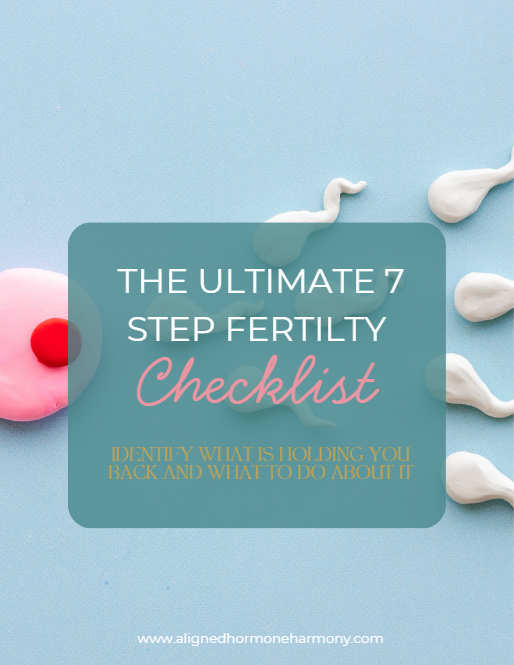
You can start exploring this in my 7 Step Fertility Checklist, which walks you through the key pillars of supporting your body from the ground up.
When you shift from chasing symptoms…to addressing the root cause, you stop the endless trial and error.
You are not broken!
If you take one thing from this, let it be this:
Your body is not failing you.
It's responding to its environment and when that environment changes your body will respond differently.
Your next step
If you’ve been told “everything looks normal” but you know something isn’t right, this is your invitation to look deeper.
Start by identifying what may be impacting your body beneath the surface.
Download the 7 Step Fertility Checklist to begin connecting the dots and understanding your unique fertility picture.
Or, if you’re ready for personalised guidance: book a Fertility Clarity Call, where we map out what’s really going on and your next steps without overwhelm.
Finally....
You are not “unexplained.”
You are simply looking for answers in a system that hasn’t been designed to dig deep enough.
And once you start looking in the right place…
Everything begins to make sense.
Thank you for subscribing!
Check your spam or junk folder for an email from donna@alignedhormoneharmony.com and mark me as a safe sender to receive your checklist.